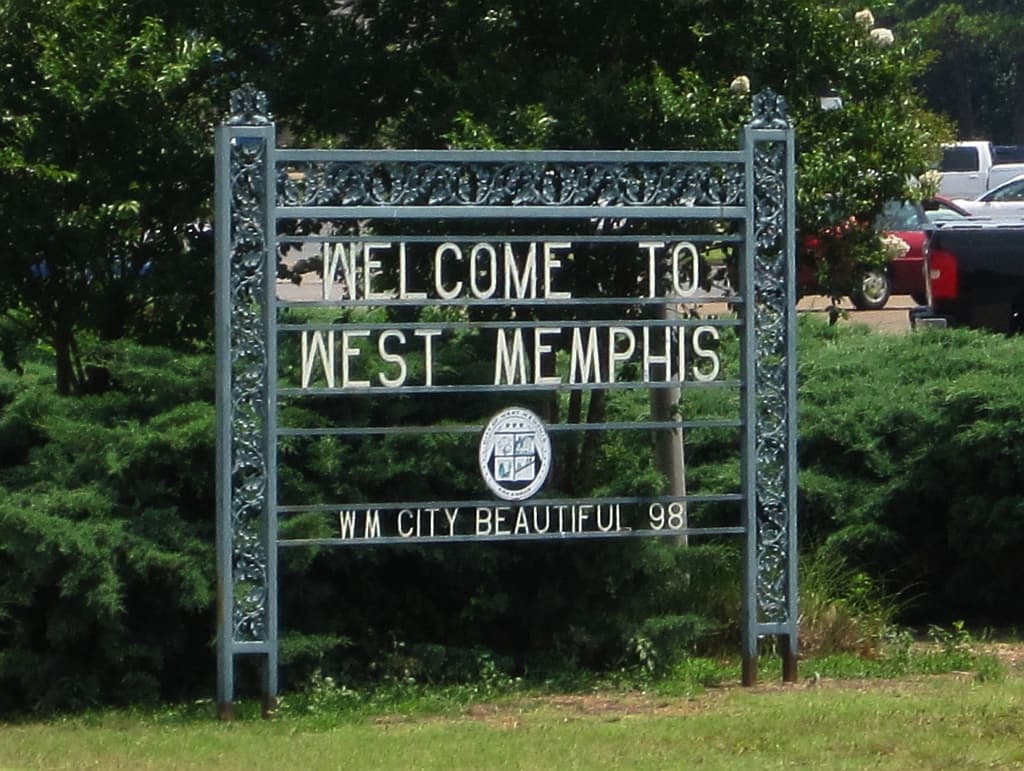
Coords: 35.1628262, -90.1709059
ADVERTISEMENT
This page contains affiliate links. We may earn a small commission at no extra cost to you.
Author: Jewls Krueger
Robin Hood Hills is a patch of woods off Interstate 40 in West Memphis, Arkansas, where the bodies of three eight-year-old boys were found on May 6, 1993. The case that followed, in which three local teenagers were convicted on the theory that the killings were a satanic ritual, became one of the most scrutinized prosecutions in American criminal justice.
Three HBO documentaries, beginning with "Paradise Lost: The Child Murders at Robin Hood Hills," turned the case into a national cause and gave it the name by which many now know it. The convicted men, known as the West Memphis Three, were released in 2011 but never fully exonerated, and the question of who killed the boys remains formally unresolved.
Steve "Stevie" Branch, Christopher Byers, and Michael Moore were all eight years old and second graders at Weaver Elementary School. The three were friends and belonged to the same Cub Scout pack. On the afternoon of May 5, 1993, they went bike riding in their West Memphis neighborhood and did not return home for dinner. Their parents began calling police that evening, and a limited search of the area turned up nothing that night.
The following morning, a more thorough search focused on Robin Hood Hills. Around 1:45 p.m. on May 6, a juvenile parole officer spotted a boy's shoe floating in a drainage canal, and the bodies of all three boys were recovered from the water. They had been stripped and bound with their own shoelaces. Autopsies by the state medical examiner concluded that Moore and Branch died of multiple injuries with drowning, while Byers died of multiple injuries.
Police focused early on Damien Echols, an eighteen-year-old who wore black, listened to heavy metal, and had an interest in Wicca and the occult. He had a documented history of mental illness. Within weeks, investigators also arrested his friend Jason Baldwin, sixteen, and Jessie Misskelley Jr., seventeen, an acquaintance with a reported IQ of 72. No physical evidence connected any of the three to the crime scene. Supporters have long argued that the teenagers were targeted because they were social outsiders in a conservative Bible Belt town during the era of the so-called Satanic Panic.
ADVERTISEMENT
The case against the three rested heavily on a confession Misskelley gave after roughly twelve hours of police questioning, conducted without a lawyer or parent present and only partly recorded. He implicated Echols and Baldwin, then recanted, and his statement contained factual errors about the timing and circumstances of the killings. An expert on false confessions testified at his trial that the interrogation showed signs of coercion. Because the confession could not be used against his co-defendants under the Bruton rule, Misskelley was tried separately.
Misskelley was convicted in February 1994 of one count of first-degree murder and two counts of second-degree murder, and sentenced to life plus 40 years. Echols and Baldwin were tried together the following month. Prosecutors called a witness who testified that the killings bore the marks of a satanic ritual, and much of the remaining evidence was circumstantial, including fibers said to be similar to clothing found in the defendants' homes. Both were convicted of three counts of murder in March 1994. Echols, whom prosecutors described as the ringleader, was sentenced to death, while Baldwin received life in prison.
DNA testing conducted in 2007 found no genetic material at the scene matching Echols, Baldwin, or Misskelley. One hair recovered from a ligature was reported to be "not inconsistent with" Terry Hobbs, Stevie Branch's stepfather, who was questioned but never charged and has consistently denied involvement. Combined with allegations of juror misconduct, the new evidence led the Arkansas Supreme Court in 2010 to order a lower court to reconsider the convictions.
Rather than face new hearings, prosecutors offered a deal. On August 19, 2011, the three men entered Alford pleas, a rare arrangement that let them assert their innocence while acknowledging that the state had enough evidence to convict. A judge vacated the original convictions, sentenced the men to the 18 years they had already served, and released them with suspended sentences. By that point, two of the victims' families had come to doubt the convictions.
The men have continued to seek full exoneration. In April 2024, the Arkansas Supreme Court affirmed that Echols could pursue advanced DNA testing, and in the summer of 2025 a Crittenden County judge approved an agreed order to test ligatures, hairs, and other items using modern methods. The evidence, including the shoelaces used to bind the boys, was sent to Bode Laboratories in Virginia. As of mid-2026, the defense said testing was expected to be completed around the end of July, with results still pending. All three men agreed to the testing despite the risk that the process could consume the remaining evidence.
Book Recommendation

Damien Echols' "Life After Death" is the definitive West Memphis Three account written by the man who spent 18 years on death row for a crime the evidence suggests he didn't commit.
Buy on Amazon →By purchasing through this link, we may earn a small commission at no extra cost to you. Thank you for supporting our work!
Robin Hood Hills remains a wooded area off Interstate 40 in West Memphis, bordered by residential streets and cut through by the service roads and drainage canals where the boys were found. It is not a formal memorial or attraction, and the ground itself is ordinary terrain beside an active neighborhood.
A memorial to Stevie Branch, Christopher Byers, and Michael Moore was erected in 1994 on the playground of Weaver Elementary School, where all three were students, and was refurbished for the twentieth anniversary of their deaths. The case is documented at length in the three "Paradise Lost" films and in investigative journalist Mara Leveritt's book "Devil's Knot: The True Story of the West Memphis Three," which was adapted into a 2013 feature film.
Visitors drawn by the case should remember that this is a living community and, for the families involved, the site of an unresolved tragedy. Stay on public roads and sidewalks, do not enter private property or the woods themselves, and avoid contacting residents or anyone connected to the case. The most respectful way to engage with this story is through the extensive documentary and written record it has produced.

The first "Milk Carton Kid" Johnny Gosch went missing from near his suburban Iowa home
Twelve-year-old Courtney Sconce was abducted from this corner in 2000.
Jessica Keen was abducted and found murdered in this small, rural cemetery.
A Quick Note From Our Founder
Morbid Tourism is independently researched and maintained by one person. Every location is fact-checked, verified, and mapped so you can find exactly what you're looking for. If this page helped you, a coffee keeps the research going.