1700 North Airfield Drive, Grapevine, TX 76051
This page contains affiliate links. We may earn a small commission at no extra cost to you.
Author: Jewls Krueger
On the afternoon of August 2, 1985, Delta Air Lines Flight 191, a Lockheed L-1011 TriStar wide body jet flying from Fort Lauderdale, Florida to Los Angeles with a scheduled stop in Dallas/Fort Worth, crashed short of the runway while attempting to land at Dallas/Fort Worth International Airport.
The crash killed 137 of the 163 people on board, along with one person on the ground. It remains one of the deadliest aviation accidents in Texas history and led to sweeping changes in how the U.S. aviation industry detects and warns of dangerous weather near airports.
Delta Flight 191 was a regularly scheduled transcontinental flight from Fort Lauderdale-Hollywood International Airport in Florida to Los Angeles International Airport, with an intermediate stop in Dallas. The aircraft was a Lockheed L-1011-385-1 TriStar, registration N726DA, that had entered service with Delta in 1979. The flight crew consisted of Captain Edward "Ted" Connors, 57, First Officer Rudy Price Jr., 42, and Flight Engineer Nick Nassick, 43, all of them highly experienced pilots.
The flight departed Fort Lauderdale around 3:10 p.m. local time and proceeded westward toward Dallas, carrying 152 passengers and 11 crew members. As the aircraft approached the Dallas area, the crew observed a building line of thunderstorms over the airport but were cleared by air traffic control to continue an instrument approach to Runway 17L.
Unknown to the crew or controllers at the time, a localized but extremely intense weather phenomenon known as a microburst had developed inside the thunderstorm directly in the path of Flight 191. A microburst is a powerful, narrow column of sinking air capable of generating sudden, severe wind shear near the ground, with winds reversing direction rapidly across a very short distance.
At approximately 6:05 p.m. local time, as Flight 191 descended through 800 feet on final approach, the aircraft encountered the leading edge of the microburst. The plane was first lifted by a headwind, then almost instantly hit by a powerful downdraft and a violent tailwind. Despite the crew's efforts to recover, the aircraft lost lift and struck the ground in a field about a mile north of the runway.
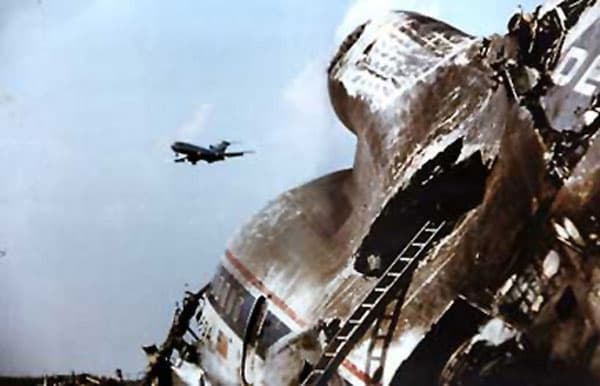
The plane bounced, crossed State Highway 114, and struck a car driving on the highway, killing the driver. The aircraft then continued into the airport perimeter, where it broke apart and collided with two large airport water tanks, igniting a major fire.
Of the 163 people aboard, 134 were killed at the scene and three more died later from their injuries, bringing the total death toll on the aircraft to 137. The driver who was struck on the ground was also killed. Twenty seven people aboard the plane survived, most of them seated in the rear of the cabin, which had separated from the rest of the aircraft before the impact with the water tanks.
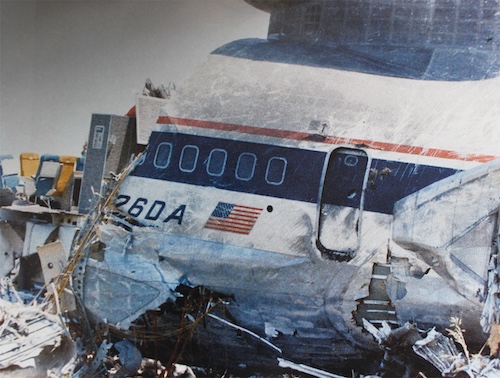
The wreckage of Delta 191 - Public Domain
The National Transportation Safety Board (NTSB) launched an immediate investigation. After a 13 month inquiry, the agency released its final report in August 1986. The NTSB concluded that the primary cause of the crash was the flight crew's decision to initiate and continue the approach into a thunderstorm cell containing a severe and visible microburst, combined with the lack of specific weather information about the location and intensity of the microburst and a lack of crew training in microburst recognition and recovery.
The investigation had a transformative effect on aviation safety. In its wake, the Federal Aviation Administration required the installation of Doppler radar based Terminal Doppler Weather Radar (TDWR) systems at major U.S. airports to detect microbursts and wind shear before they could threaten aircraft. Airlines also began incorporating microburst recognition and recovery procedures into pilot training programs, and onboard wind shear detection and warning systems became standard equipment on commercial aircraft.
Further Reading

A separate civil lawsuit was filed against the federal government by Delta on behalf of victims' families. In 1989, a federal judge ruled the government partially liable for the crash, finding that air traffic controllers had failed to provide adequate warning of the storm. The total settlements paid to families exceeded $130 million.
The crash site sits inside the boundaries of Dallas/Fort Worth International Airport in Grapevine, Texas, just south of State Highway 114 on the north end of the airport's runway complex. The field where the aircraft first impacted has long since been resurfaced and incorporated into airport operations.
In 2010, on the 25th anniversary of the crash, the Founders' Plaza Observation Area at the airport added a permanent memorial honoring those killed on Flight 191. The memorial features a granite marker, the names of all 137 victims, and a moment of silence ceremony each year on the anniversary of the accident. The Founders' Plaza is located at 1700 North Airfield Drive in Irving, Texas and is open to the public during daylight hours.
The actual crash site is within secured airport property and not accessible to the public. Please be respectful when visiting the memorial, follow all posted signage at Founders' Plaza, and stay clear of active airport operations.
A Quick Note From Our Founder
Morbid Tourism is independently researched and maintained by one person. Every location is fact-checked, verified, and mapped so you can find exactly what you're looking for. If this page helped you, a coffee keeps the research going.