23 Washington Pl, New York, NY 10003
This page contains affiliate links. We may earn a small commission at no extra cost to you.
Author: Jewls Krueger
On the afternoon of Saturday, March 25, 1911, a fire broke out at the Triangle Shirtwaist Factory on the top three floors of the Asch Building in Greenwich Village, New York City. Within just 18 minutes, 146 garment workers, most of them young immigrant women and girls, were dead.
The fire became one of the deadliest industrial disasters in American history and helped drive sweeping changes to workplace safety laws, fire codes, and the American labor movement.
The Triangle Waist Company, more commonly known as the Triangle Shirtwaist Factory, was owned by Max Blanck and Isaac Harris, two men who had built one of the largest manufacturers of women's blouses in the country. Their factory occupied the eighth, ninth, and tenth floors of the 10 story Asch Building at the corner of Washington Place and Greene Street, just east of Washington Square Park.
Roughly 500 workers were employed at the factory. The vast majority were young immigrant women, primarily Jewish women from Eastern Europe and Italian women, many of them teenagers. Some workers were as young as 14. They typically worked nine hour days during the week and seven hour days on Saturdays for wages between $7 and $12 per week, sewing cotton blouses on rows of crowded sewing machines.
Blanck and Harris had a reputation for fiercely anti union management. In 1909, the Triangle workers had played a central role in the "Uprising of the 20,000," a citywide garment worker strike led mostly by young immigrant women. Triangle did not sign the agreement that ended the strike, and conditions at the factory remained largely unchanged.
At approximately 4:40 p.m. on Saturday, March 25, 1911, with workers preparing to leave for the day, a fire broke out in a scrap bin under one of the cutting tables on the eighth floor. Investigators later determined it was likely caused by an unextinguished match or cigarette igniting the months of accumulated fabric scraps. The factory floor was packed with cotton fabric, paper patterns, and wooden tables, all of which fueled the flames almost instantly.
Workers on the eighth floor sounded the alarm and most managed to escape down the Greene Street stairway or the building's two passenger elevators. The tenth floor, which housed the company's executive offices, was also able to evacuate, with most workers escaping to the roof and onto the roof of the neighboring NYU building.
Further Reading
The ninth floor was where most of the deaths occurred. Workers there were not notified of the fire until it was already on their floor. By the time they realized what was happening, the Greene Street stairway was filling with smoke and flames. The Washington Place stairway door had been locked from the outside, a common practice at the time to prevent unauthorized breaks and theft. The single rusty fire escape on the back of the building collapsed under the weight of fleeing workers, sending many to their deaths.
With escape routes cut off, dozens of workers jumped from the eighth and ninth floor windows to escape the flames. New York Fire Department ladders only reached as high as the sixth floor, and the safety nets firefighters held below tore under the impact of falling bodies. In all, 146 people died, 123 women and girls and 23 men, in just 18 minutes.
Interested in seeing the Triangle Shirtwaist Factory Fire in person? Take the tour →
Owners Max Blanck and Isaac Harris were indicted in April 1911 on charges of first and second degree manslaughter, with prosecutors specifically targeting the locked Washington Place stairway door. The trial began in December 1911 and lasted three weeks.
Defense attorney Max Steuer cast doubt on the testimony of workers by suggesting they had memorized their statements, and argued that prosecutors had not proven the men knew the door was locked at the time of the fire. On December 27, 1911, a jury acquitted both Blanck and Harris. In a later 1913 civil suit, the men were ordered to pay $75 in damages per deceased victim to the families who had sued. Their insurance company paid them roughly $400 per victim, meaning they actually profited from the fire.
In 1913, Blanck was arrested again for locking the door of his factory during working hours. He was fined $20.
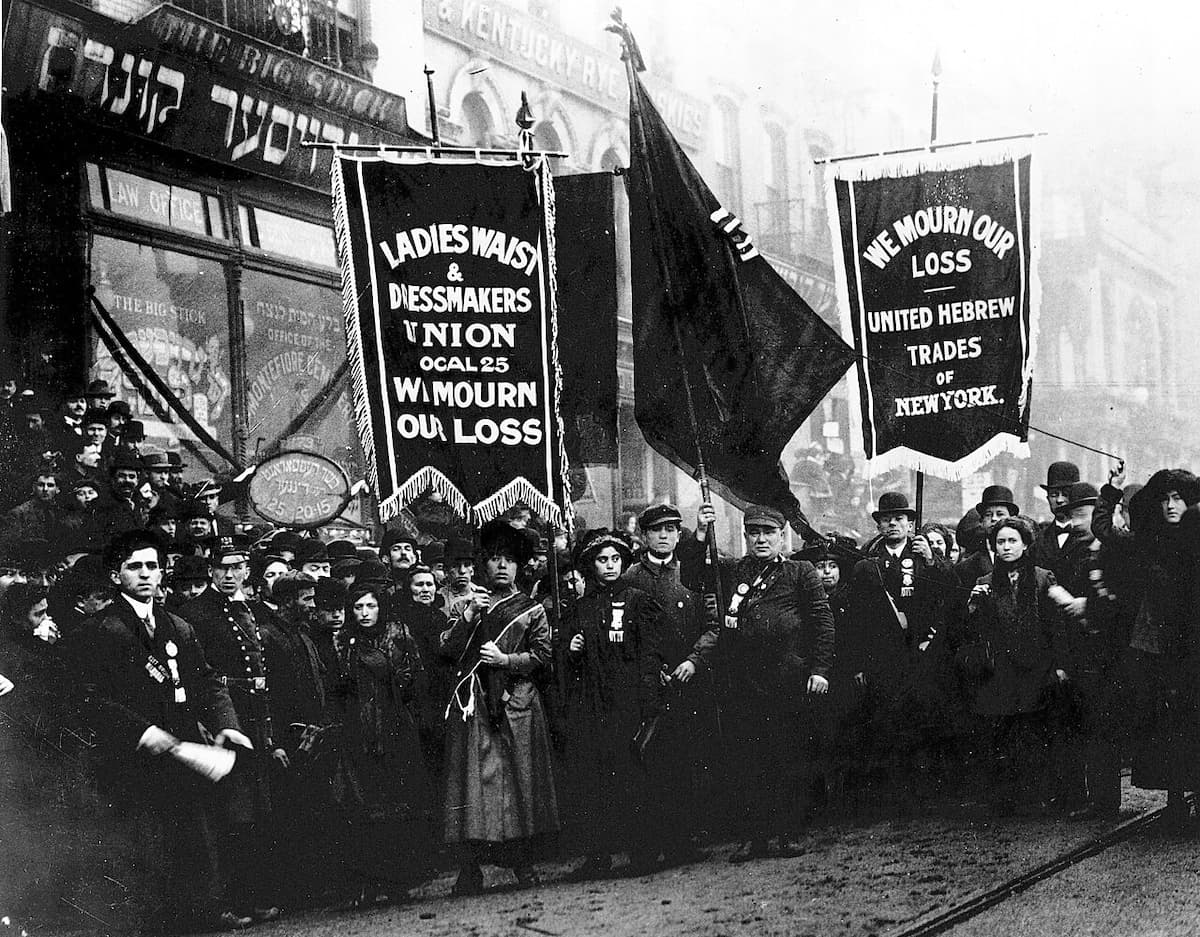
The fire shocked the country and triggered a massive public outcry. In its wake, New York State established the Factory Investigating Commission, led by future U.S. Senator Robert F. Wagner and future New York Governor Al Smith. Over the next three years, the commission helped pass more than 30 new state laws related to fire safety, factory inspections, child labor, and worker hours.
The disaster also energized the American labor movement, particularly the International Ladies' Garment Workers' Union, which grew rapidly in the years that followed. A young Frances Perkins, who witnessed workers jumping from the building that afternoon, later credited the fire with shaping her life's work in labor reform. As U.S. Secretary of Labor under Franklin D. Roosevelt, Perkins would go on to be a key architect of the New Deal, including the establishment of Social Security and federal minimum wage and overtime laws.
The Asch Building still stands today at 23-29 Washington Place, on the northwest corner of Washington Place and Greene Street, just east of Washington Square Park in Manhattan's Greenwich Village. It is now owned by New York University and is known as the Brown Building. It houses NYU science classrooms and laboratories.
The building was designated a National Historic Landmark in 1991 and a New York City Landmark in 2003. Two plaques have been placed on the exterior of the building to commemorate the fire, one installed by the ILGWU in 1961 and another by the City of New York.
In October 2023, after years of planning and fundraising, a permanent memorial called the Triangle Fire Memorial was dedicated on the exterior of the building. Designed by Richard Joon Yoo and Uri Wegman, it features a stainless steel "collar" wrapping the lower facade of the building with the names of all 146 victims and a reflective ribbon descending from the ninth floor.
The memorial is on a public sidewalk and visitors are welcome at any time. Please be respectful of NYU students and faculty entering and exiting the building, and stay on the public sidewalks during your visit.
Explore NYC's darkest history with this NYPD-guided true crime and mafia walking tour — one of the city's highest-rated dark tourism experiences, with food included.
A Quick Note From Our Founder
Morbid Tourism is independently researched and maintained by one person. Every location is fact-checked, verified, and mapped so you can find exactly what you're looking for. If this page helped you, a coffee keeps the research going.